
For Patients & Families
About avatar therapy
If you have been told about avatar therapy, or if someone close to you is being offered it, this page explains what it is and what to expect. The decision about whether avatar therapy is the right treatment for you is one to make with your clinician.
Please note: Heka VR does not provide treatment directly. To access avatar therapy, please speak with your treating clinician.
What it is
A new way of working with a difficult inner voice
Many people living with a serious mental illness experience intrusive thoughts. For some, this is heard as voices, what clinicians call auditory hallucinations. For others, it takes the form of a persistent, critical inner commentary, sometimes about food and weight, sometimes about cleanliness, sometimes about being unsafe or unworthy. Whatever its form, this voice often becomes more powerful over time, and many people come to feel they have little control over it.
Avatar therapy is designed to help with this. With a trained clinician, you create a digital version of your voice — something you can see and hear, outside of you, instead of only inside your head. You then have structured conversations with this digital version, called an avatar, while your clinician guides the session. Over time, the avatar's hold weakens. Your own voice — the part of you that knows what you want and what matters to you — grows stronger.
A session
What actually happens
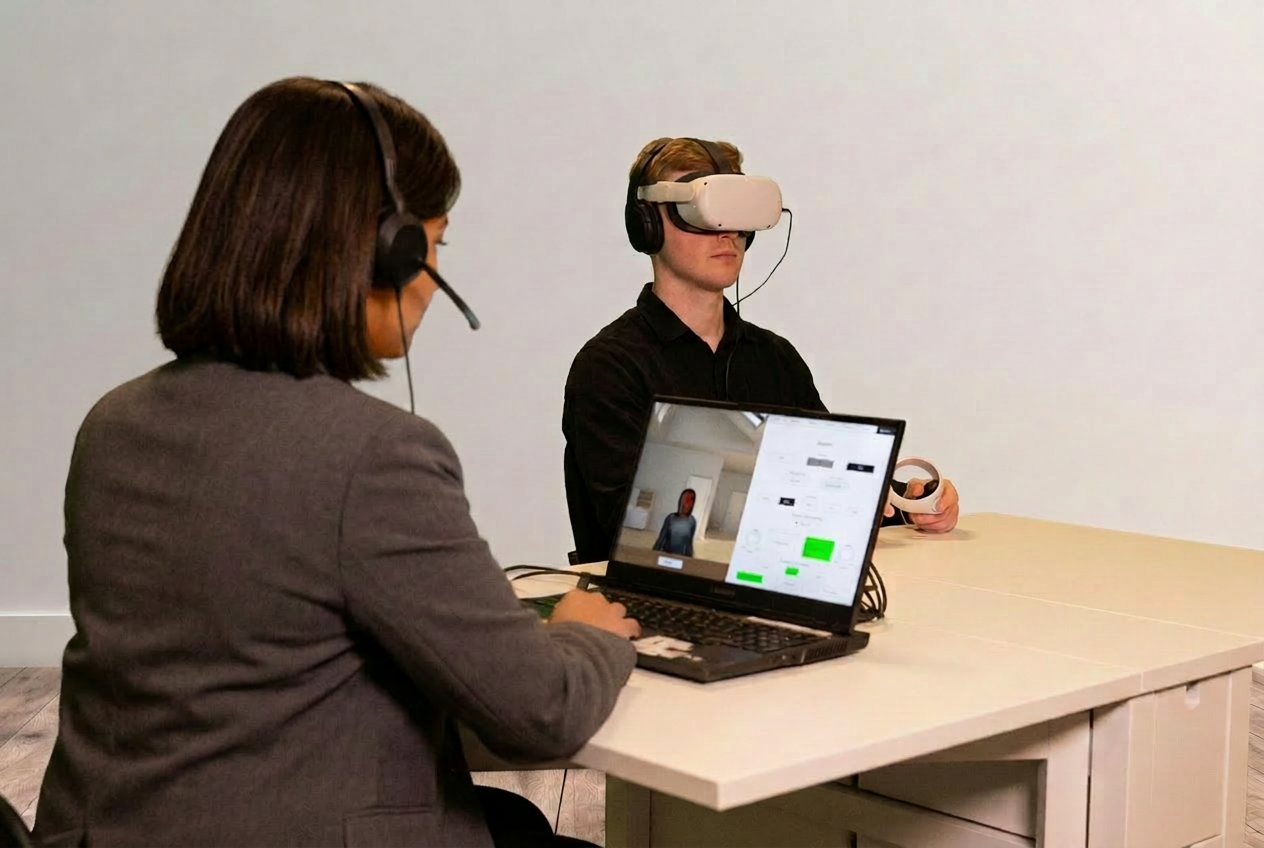
You meet with your clinician in their usual room. You sit next to each other. You wear a VR headset and headphones, which let you see and hear the avatar. Your clinician sits beside you the whole time, controlling the dialogue from a laptop and stepping in to support you.
A typical session lasts about an hour. Part of that time is spent in conversation with the avatar — sometimes only a few minutes, sometimes longer, depending on what you and your clinician are working on in that session. The rest of the hour is preparation beforehand and reflection afterwards. A full course is usually seven sessions.
In the first session, you and your clinician spend time understanding your voice — what it says, how it sounds, what it looks like to you — and together you build the avatar that represents it. In later sessions, you practice speaking back to it. This is often difficult, especially at the start. Most people find it gets easier as the sessions progress.
A patient's story
Sofie's experience
Sofie Olsen took part in the CHALLENGE trial. Al Jazeera featured her experience in their documentary on Denmark, mental health and technology.
Who it is for
Who avatar therapy is offered to
Avatar therapy is most established as a treatment for people with schizophrenia who hear distressing voices, particularly when other treatments have not given enough relief. Research is also underway into avatar therapy for eating disorders, OCD and other conditions where a dominant inner voice plays a role.
Avatar therapy is not a replacement for the care you already receive. It is offered alongside your usual treatment, and your existing clinical team remains responsible for your overall care.
What to expect
Honest about what this is like
Speaking to a representation of your most difficult inner voice can be emotionally demanding, particularly in the first sessions. This is part of how the treatment works — but it is also why your clinician is with you throughout, why sessions are paced carefully, and why the avatar's intensity is something you and your clinician can adjust together. If you find a session difficult, your clinician will help you through it and you can take breaks or step back at any time.
Some people experience mild simulator sickness from the VR equipment, similar to motion sickness. This usually settles after the first one or two sessions.
Clarifications
What it is not
Avatar therapy is not a virtual reality game. It is a clinical treatment delivered by a trained psychiatric professional.
Avatar therapy is not something you do at home or on your own. It is delivered in a clinical setting, with your clinician.
Avatar therapy is not a cure, and it does not work the same way for everyone. Like all psychiatric treatments, it helps some people more than others. Your clinician is the right person to discuss with you whether it is likely to be helpful in your situation.
Access
Talking to your clinician
Avatar therapy is currently available through a number of psychiatric hospitals and clinics in Europe, with research studies running in further countries. If you are interested in whether it might be appropriate for you, the right next step is to talk to your treating clinician — your psychiatrist, psychologist, or care team. They can advise on whether it is available in your service or in your region, and whether it is clinically suitable for your situation.
If you are a clinician reading this page on behalf of a patient and would like to know whether avatar therapy is available in your area, you are welcome to contact us.
For families
If someone you care about is being offered avatar therapy
Being offered a new treatment can raise questions for the people around the patient as well. You are welcome to read this page, and to discuss it with the person in treatment and with their clinical team. Avatar therapy is structured, evidence-based, and delivered by trained professionals; the dialogue with the avatar happens in a controlled clinical setting, with the clinician present throughout.
If you are in immediate distress, please contact your local emergency services or your treating clinician.